
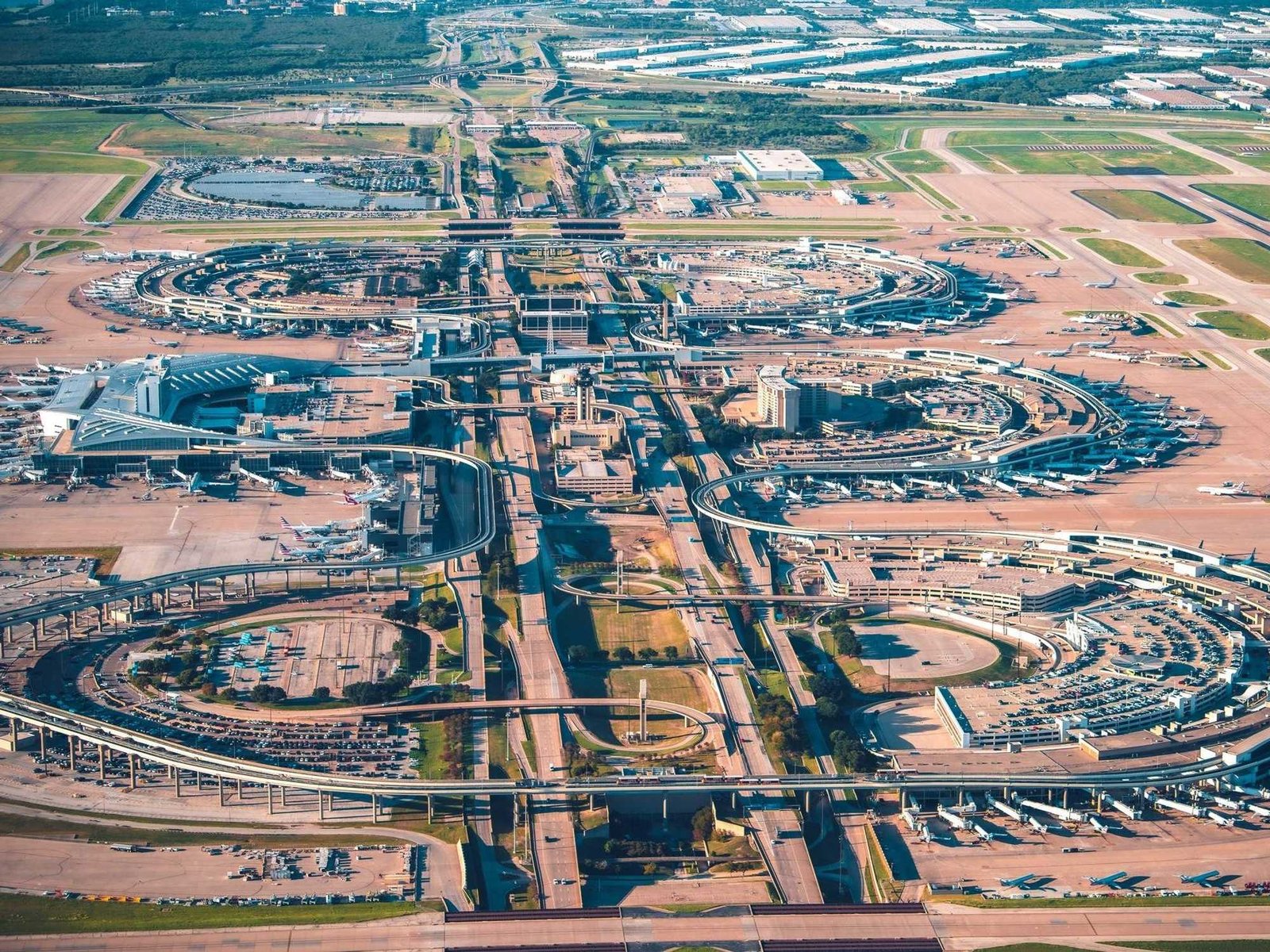

Work in and around DFW Airport is concrete work done under rules: height limits for booms, badge checks at the gate, restricted areas and flight operations that never stop. We build cargo-adjacent pavement, hotel and office foundations, rail-station paving and the underground systems that serve them, and we plan every pour around the airport environment instead of discovering it on the first day.
The airport is huge. Spread over 17,207 acres of Tarrant and Dallas counties next to Grapevine, Irving, Euless and Coppell, DFW is the largest hub for American Airlines and handled 85,660,127 passengers and 858,952.3 tons of cargo in 2025. Land around an operation of that size fills with freight forwarders, hotels, rental car facilities, parking and logistics buildings, all of which need concrete and utilities.
We do not claim any airport project as ours. What we bring is the discipline airport-area owners look for: careful sequencing, documented safety procedures, clean sites and testing records that arrive when promised. Our trade partners are comfortable working alongside security and operations staff.
Access, security and equipment limits
Airport-area sites often have controlled access. Workers may need background checks or badges, vehicles may be inspected and deliveries may be limited to certain gates. We submit crew and vehicle lists early, brief workers on restricted areas and assign a named escort or coordinator where the owner requires one.
Equipment height is a constant concern. Pump booms, cranes and even tall stockpiles can interfere with flight paths or lighting, so we list the equipment we plan to use, with heights and swing radius, and have the owner or operator confirm it before mobilizing. Foreign object debris is controlled with sweeping, covered loads and clean haul routes. A single stray piece of rebar tie wire can matter near an airfield, and we treat it that way.
Approvals that run through the airport
The airport was dedicated in September 1973 and opened for operations on January 13, 1974; according to DFW's fast facts page updated September 2026, it covers more than 26.9 square miles, with 17,183 acres of real property, five terminals, over 160 gates and seven runways (four at 13,400 feet, two at 9,000 and 9,300 feet, and one at 8,500 feet). A property of that size has its own design standards, permitting offices and tenant guidelines, and a project on or adjacent to airport land may need approvals beyond a city permit.
We read those guidelines with the owner at the start. Submittal formats, mix designs, traffic control plans, erosion controls and utility coordination are prepared to the airport-area owner's requirements, and we keep a log of every review comment. A late approval is a schedule problem, so we chase them from day one.
Corridors, freeways and drainage
International Parkway links to State Highway 183 (Airport Freeway) on the south side and State Highway 114 (John W. Carpenter Freeway) on the north, and past SH 114 the parkway turns into State Highway 121. Those links are how materials arrive, so haul routes are tied to freeway ramps and the airport's own roads. On a day with a major event or a weather disruption, traffic can slow dramatically, and our plan includes alternate routes.
Large pavements and roofs in airport-area parks shed a lot of water, so drainage design and construction deserve attention. We build storm drain installation, inlets and culverts and headwalls with careful grade control, test every line and check outfalls after the first heavy rain.
Round-the-clock operations and night work
By DFW's own figures, over 86 million customers a year pass through, with 193 domestic and 77 international nonstop destinations and 21 cargo airlines flying freighters, and the airport's annual economic impact tops $78 billion, supporting 684,000 jobs directly and indirectly. With that level of activity, quiet windows are short, and night work is common. We plan lighting, noise limits and crew rest, and we make sure batch plants can supply the pours at the hours required.
Phasing is the other tool. We break paving and slab work into sections that can be completed and opened quickly, with temporary barriers and signs to keep traffic safe. Sequences are shown on a plan that the owner's operations team can review, and changes are communicated the same day.
Planning around trains and tenants
Rail access includes the DART Orange Line from the Terminal A station to Dallas and Las Colinas, the DART Silver Line from the Terminal B station, TEXRail from the Terminal B station to T&P Station in downtown Fort Worth, and the Trinity Railway Express at CentrePort/DFW Airport station. Rail connections mean station-area plazas, platforms and sidewalks, with transit agencies as stakeholders and strict clearances around tracks.
We approach those projects by mapping stakeholders first, then the work. A rail agency, an airport operator, a hotel owner and a city may all have a say in a single sidewalk. We build a communication chain, hold coordination meetings and record each decision. Nearby Irving and Grand Prairie projects give us equipment close by, and hospitality hotel construction around the terminals follows many of the same rules.
Crews that can work on short notice
Airport owners often need a repair or a small expansion done fast. Our trade partners can sawcut, remove and replace pavement, pour a pad, set a vault and restore a surface on one coordinated schedule. That responsiveness is one of the main reasons owners choose a contractor they can call.
For logistics and warehouse developers, we offer a standing program: a priced list of common repairs, response times and a named foreman. Larger projects use the same people, so the foreman who knows the gate procedures on a small job is available to lead the large one.
Plan an airport-area project with us
Tell us the site, the access constraints and the dates that matter most. We will return a sequence that respects the airport environment and a price that shows each constraint as a line item. If the project is a cargo or freight building, also see our work in Alliance.
Common Questions
Do you hold the credentials needed to work on airport property?
Credentials and badging are issued by the airport or the tenant, not by the contractor. We submit worker information early, attend the required safety orientation and follow the escort and vehicle rules. Our trade partners are used to working under those conditions.
How do you handle pump booms near flight paths?
We list the equipment and heights in advance and ask the owner or airport operator to confirm. Where height is limited, we choose a smaller boom or a line pump, and we adjust the pour plan. We never raise a boom without clearance in writing.
Can you work at night?
Yes. We plan lighting, noise control and crew scheduling for night pours, and we confirm batch plant hours. Night work also needs traffic control and safe access for inspectors, which we arrange in advance.
What do you do about debris near an airfield?
We sweep haul routes, cover loads, secure loose materials and keep the site clean. Rebar tie wire, concrete chunks and plastic are collected daily. A designated crew member inspects the work area at the end of each shift.
Can you work for tenants and not only for the airport authority?
Yes. Hotels, freight forwarders, rental car operators and logistics tenants near the airport hire us directly or through their general contractors. We follow the landlord's rules and coordinate with the airport where necessary.