
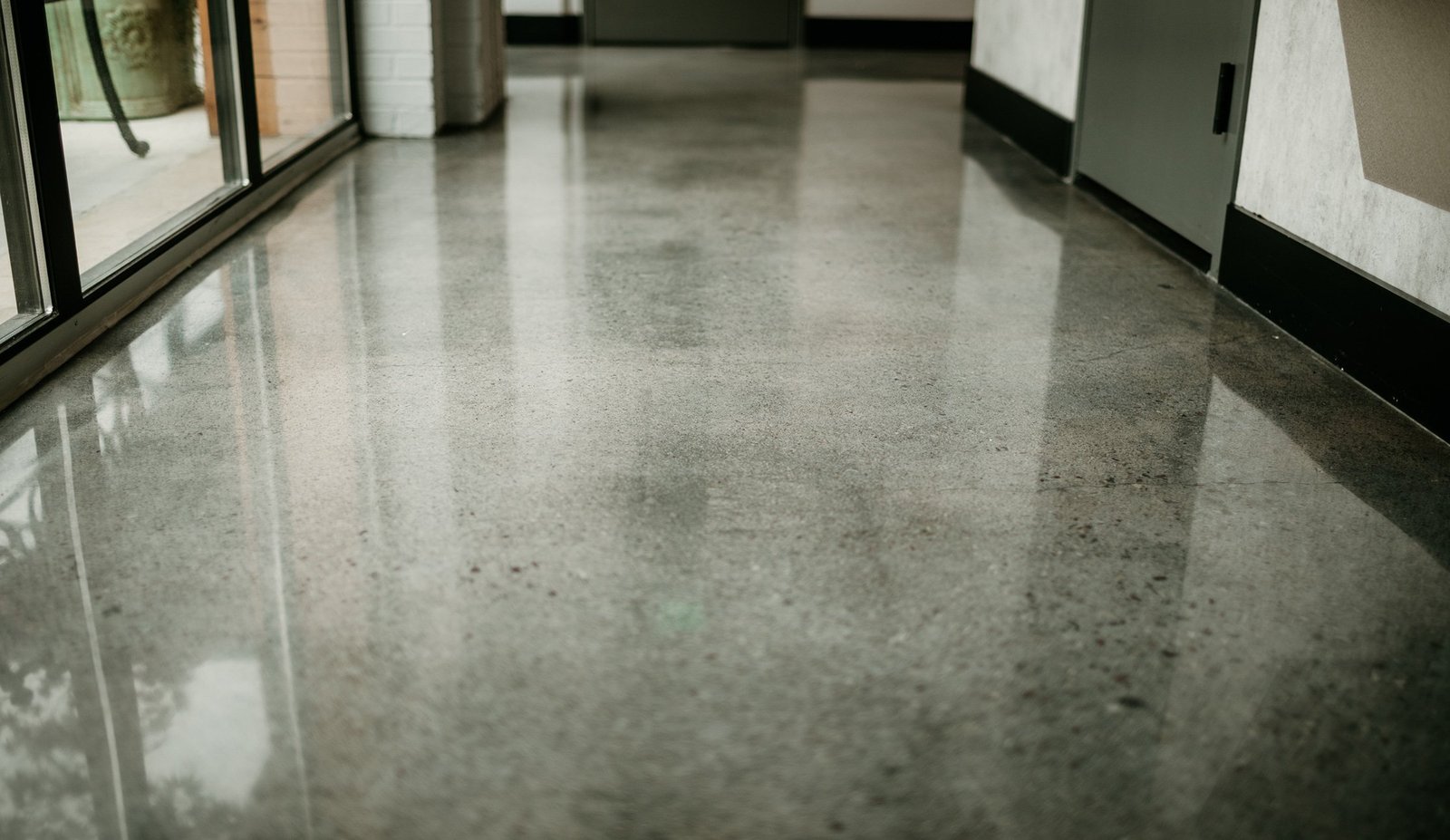

Polish reveals everything the finishers did, and everything they did not do. A grinder can bring up trowel marks, patched cracks, color variation from uneven curing and the aggregate hiding under the cream, so the quality of a polished floor is mostly settled on the day the slab is placed, long before any diamond tooling touches it. We build polished concrete floors for retail, education, aviation and light industrial buildings across Texas, and we start the conversation about the final surface before the mix design is signed off.
Polishing is not an add-on that a floor sub can bolt onto a slab at the end. It is a sequence: placement and finishing suited to grinding, controlled curing, careful joint treatment, stages of grinding with progressively finer tooling, a densifier that hardens the surface, and a guard or sealer that sets the sheen and stain resistance. A polished floor is the finished floor in a building, so owners should see the plan for each stage.
The sequence from slab to sheen
On a new slab we begin with a mix that is consistent from truck to truck, a flat finish without burn marks, and a cure that does not leave residue or uneven color. After the slab has gained strength and dried, joints are cleaned and filled, and grinding starts with coarser metal-bond tooling that removes the surface paste to the depth the owner chose, from a light cream finish to a salt-and-pepper or full aggregate exposure.
Finer resin-bond tooling follows, and a densifier penetrates and hardens the surface before the final polishing passes. The last stage is a guard or sealer, applied to reduce staining and ease cleaning, and burnished to the sheen specified. Where a plain finish is wanted but color or pattern is also part of the design, the decorative and stamped concrete crews we coordinate can add stain, dye or scoring.
Planning for the floor owners will see
The most valuable thing we do is mock up the surface. A test panel on the actual mix, ground to the agreed exposure and sheen, lets the owner, designer and general contractor look at the same floor before it is applied to ten thousand square feet. We use the mockup to settle questions about aggregate show, saw-cut joints, coloring and gloss, and to record the grinding steps that produced the result.
On the pour day, we protect the slab from construction traffic, steel dust and chemical spills, and we schedule other trades so that no paint, drywall mud or oil lands on the future polished surface. After grinding, we walk the floor with the owner's representative under work lighting and under the building's own lights, because a polished floor looks different under each.
Buildings that benefit from polished floors
Polished floors are chosen where traffic is heavy, cleaning is frequent and a dust-free surface is useful. That includes retail centers where tenants want a bright, reflective floor, schools where durability and low maintenance count, and aircraft hangars where hydraulic fluids and tires punish coatings. They also suit light manufacturing and showrooms.
Large Texas campuses show the range. A $156 million cruise terminal on Galveston's waterfront was designed by converting two cargo buildings into a 160,000 square foot terminal. In San Antonio, an aerospace-focused campus reports about 10 million square feet of existing space at more than 97 percent occupancy, and in Midland a satellite manufacturing facility of more than 400,000 square feet was approved for the airport business park. Floors in buildings of this kind are expected to be clean, durable and bright.
What shapes the cost of a polished floor
Polishing cost is driven by the condition of the slab, the number of grinding steps, the aggregate exposure and the sheen. A floor placed with grinding in mind needs less repair and fewer passes than a rough slab that has to be corrected, and that is why we recommend adding the polishing scope before the slab is bid. Joint filling, patching, densifier and guard add to the cost, as does the size of the project and the access for large machines.
Compared with sheet flooring or coatings, polished concrete has fewer layers to maintain, but it is not zero maintenance. We include a maintenance schedule and, when asked, a reapplication plan for the guard. When a general contractor or construction manager compares bids, we encourage them to compare the number of grinding steps and the tooling grit sequence as well as the price.
Joints, cracks and expectations
Concrete cracks, and a polished floor will show them. The honest approach is to set expectations at the beginning: saw-cut joints will be visible, hairline shrinkage cracks may appear, and variations in color and aggregate are part of the material. We fill joints with semi-rigid fillers that support the edges, repair cracks with approved materials and tell the owner where repairs will remain visible.
Where an existing slab is being polished, the job is different. We test the surface for hardness, coatings and contamination, then decide whether polishing, grinding or a different treatment is appropriate. The concrete repair and restoration crews we coordinate can patch spalls, fill holes and match the existing surface so the polish passes over repairs as evenly as possible, and our industrial concrete floors work informs the joint and hardener choices.
Ready to see a mockup?
Tell us the building type, the sheen you want and the date the floor needs to be done. We will propose a mix, a finishing plan and a mockup so the surface is agreed before the slab is placed.
Common Questions
Can any concrete slab be polished?
Most can, but results vary with the mix, the finishing and the condition of the surface. A slab that was heavily steel-troweled, sealed with an incompatible compound or placed with variable mixes will polish less evenly. We test and mock up before committing to a finish.
Is a polished floor slippery?
It can be, depending on the sheen and the use. Matte and satin finishes are less reflective and generally offer better traction when wet, and a guard can be selected for slip performance. For accessible routes and wet areas, we choose a finish that suits the owner's requirements.
How long does polishing take?
The grinding and polishing schedule depends on the area, the aggregate exposure and the number of steps. Large floors are polished in sections with several machines, and we plan around other trades so that the finished surface is not damaged.
Will color and aggregate look consistent across a large floor?
There will be variation, because concrete is a natural material. Consistent mix, uniform curing and a single finishing crew reduce it, and the mockup shows what range to expect.
Can polished floors go in a building that has not been enclosed?
Polishing is best done after the building is closed and trades that could stain the floor have finished. We often polish late in the schedule and protect the slab until then.