
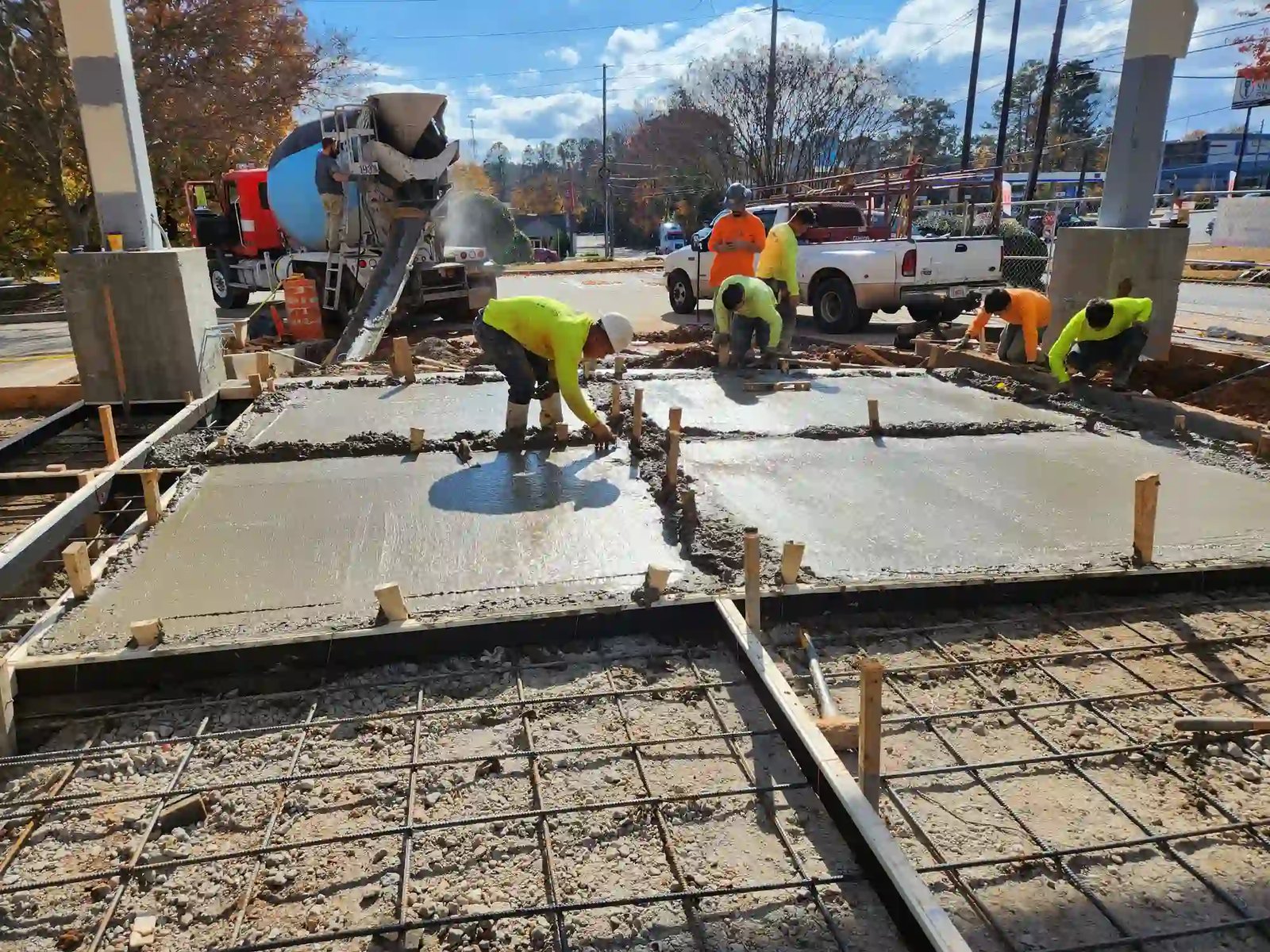
Color and pattern are the last things anyone sees and the first things a Texas climate tests. Sun fades surfaces, hard rain finds low spots, wind dries the top of a pour before the pattern is stamped and a summer afternoon can turn a half-finished plaza into a patchwork. Decorative concrete succeeds when those conditions are planned for before the first truck arrives, and when owners understand which finishes suit a high-traffic entry and which belong in a courtyard.
We install stamped, stained, integrally colored, exposed-aggregate, scored and broom-finished concrete for commercial and public clients across the state. The work is craft at the surface and engineering underneath: a thick enough section, a compacted base, a drainage plan and joints that fall where the pattern can hide them. A good decorative slab looks effortless because most of what makes it work is not visible.
Finishes we install
Stamped concrete uses textured mats and release agents to imitate stone, brick or slate, and the surface is then sealed. Integral color is added in the mixer and carries through the slab, so chips and wear are less visible than with a surface-applied stain. Exposed aggregate removes the top paste to reveal stone, producing a durable, slip-resistant face for walkways and entries. Saw-cut and scored patterns break a large pour into a grid or radial layout, while broom and light-sandblast finishes give traction at ramps and wet areas.
Most owners combine several of these in one site: a stamped band at an entry, a colored field, and a plain broom finish where trucks cross. We coordinate with sidewalks and flatwork crews so that the plain concrete and decorative concrete are placed, cured and sealed on a single schedule.
Accessibility and public-space rules
A decorative surface still has to be an accessible one. Texas administers its accessibility program through the Texas Department of Licensing and Regulation under the Texas Accessibility Standards, and projects estimated at $50,000 or more are registered and reviewed, while smaller ones must still comply. Stamped and exposed-aggregate finishes on an accessible route are therefore chosen with slope, cross-slope and surface texture in mind, and we mock up deeper patterns where there is doubt.
Where the surface meets curb ramps, we coordinate with ADA ramps and accessible routes so the transition from decorative paving to the ramp is smooth. Public owners may add their own review for plazas and streetscapes, and our submittals include color samples, pattern photographs, sealer data sheets and slip-resistance information.
Wind, heat and drainage on the day
Weather decides decorative work more than any other concrete. On the plains, a 2025 wind event at the Amarillo airport recorded a record 83 mph gust, with visibility falling below a quarter mile in blowing dust, and even ordinary days there can dry the surface of a pour fast. We use windbreaks, evaporation retarders and misting, start early in hot weather and wait for a calmer day when forecasts are marginal, because stamping a skinned surface leaves marks that cannot be removed.
Water is the other test. In El Paso, a 2006 storm dropped a year's worth of rain in two days, caused more than $200 million in damage to homes and businesses and prompted the city to create a stormwater utility in 2008. We grade decorative plazas with positive drainage, avoid birdbaths where stamped patterns could trap water and tie drains into the site storm system early in the layout.
Sequencing a pour that has to match
A decorative pour is one of the few concrete operations where a stoppage shows. Color needs consistent batching, release agents need to be applied at the right moisture, and stamping must be completed before the surface sets. We stage materials, tools and crews in advance, order concrete from a single plant when possible and place in sections that end at a joint.
After the surface is stamped, we cure and seal on a timetable set by the sealer manufacturer and weather. The sealer is the surface the public will touch, so we choose products suited to traffic and sun exposure and discuss reapplication intervals with the owner. In busy centers, sections may be opened to foot traffic in stages while the sealer cures elsewhere.
Where decorative concrete belongs
Decorative concrete is used at the entries of hotels, around fountains and pool decks, in plazas and walkways at government and municipal buildings, and along main street streetscapes. The finishes help a property read as maintained and welcoming and can guide pedestrians without extra signs.
Schools and healthcare campuses also use them. For schools and healthcare owners we focus on durability and slip performance first and look second, and we make sure that decorative bands do not create trip hazards or confusing contrast for visitors with low vision.
Protecting the investment
A decorative surface needs the same protection as any outdoor concrete. We install bollards and site concrete to keep vehicles off plazas, set expansion joints at the building edge and around fixtures, and leave room for planting areas that can be irrigated without soaking the subbase. In arid regions such as El Paso, we choose sealers and colors that hold up to intense sun.
Over time, repair is easier if we have kept records of the mix, the color formula, the sealer and the stamp patterns used. We hand those to owners at turnover so a future patch can be blended instead of replaced.
Planning a plaza, entry or walkway?
Send a plan and a photo of the finish you have in mind. We will propose pattern, color and sealer options, show you samples and put a price on the full section so you can see the base and drainage work along with the surface.
Common Questions
How long does a stamped concrete surface last in Texas?
With a sound base, good joints and periodic resealing, stamped concrete can stay attractive for many years. Sun and traffic wear the sealer first, so reapplication on the manufacturer's schedule is the main maintenance task.
Is stamped concrete slippery when wet?
It can be, especially with a high-gloss sealer. We use slip-resistant additives or textured sealers on pool decks, entries and ramps, and we recommend a matte or satin finish where wet traffic is common.
Can decorative concrete be placed in hot or windy weather?
Yes, with care. We schedule early starts, use evaporation retarders, fog and windbreaks, and are willing to postpone a pour if conditions would make it impossible to stamp or finish properly.
Will the color match from one pour to the next?
Close, not identical. Integral color is batched by weight and sampled, but cement and aggregate vary slightly between loads and days. We work in logical sections, and keep a record of the formula for future patches.