
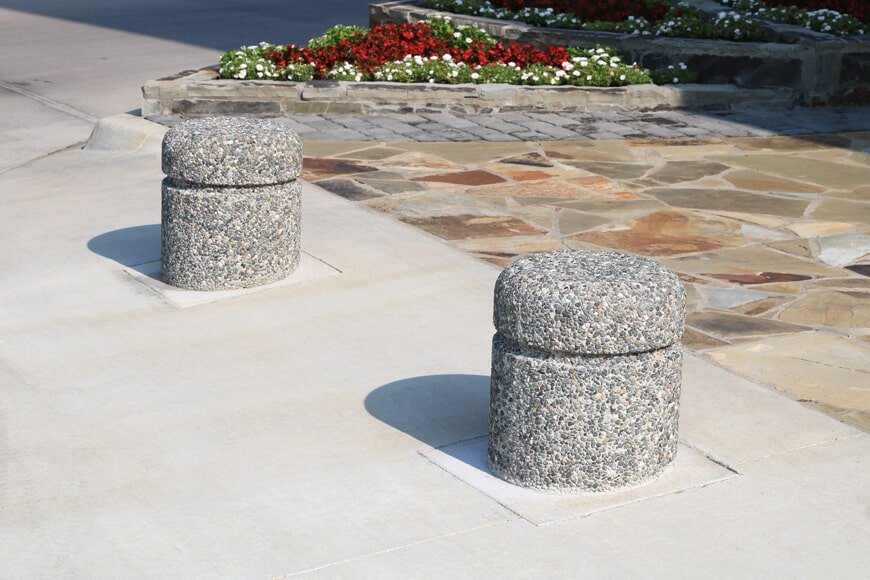

A delivery truck that loses a few inches on a tight turn can take out a gas meter, a storefront column or a transformer, and the repair bill is many times the cost of the post that would have stopped it. Bollards are the cheapest insurance on a commercial site, and the small concrete items around them, light pole bases, dumpster pads, flagpole footings, wheel stops, sign foundations and equipment slabs, are the hardware that makes a finished site actually work.
This is also the part of construction that gets squeezed. The building is done, the paving is done, the landscape crew is waiting, and the owner suddenly remembers the fifteen items that were not on the main package. We pour them as part of the site concrete scope or as a punch-list package, and we treat them as seriously as the building slab because each one carries a safety or code role.
The key difference between small and large concrete work is coordination. A bollard has to line up with a door, a curb or a fuel dispenser. A pole base has to meet the electrician conduit, and its anchor bolts must match the pole manufacturer template. Getting dozens of small items right means reading the drawings across three or four disciplines and checking them on site.
The small pours that finish a site
Typical items include concrete-filled steel pipe bollards set in drilled holes, removable and sleeved bollards for areas where access is needed, light pole foundations with anchor bolt cages, flagpole and sign footings, dumpster enclosure pads, wheel stops and curb stops, mechanical and generator pads, bike rack and bench pads, and short sections of curb or swale that tie everything together.
Each has its own method. Pole bases are generally drilled piers with a reinforcing cage and a template for the bolts, and we use our drilled pier practices at small scale. Bollards are set in holes sized to the engineer detail, filled with concrete and crowned at the top to shed water. Dumpster pads must be thick enough for heavy trucks and sloped toward a drain. We set elevations with a level, not by eye, because small errors show.
Where bollards matter most
Airports and event venues are two of the hardest sites. McKinney National Airport is described as a general aviation airport that the city bought in 1979, with a 2023 terminal expansion and city approval in January 2025 of a $72 million commercial airline terminal on the east side. A terminal that handles commercial passengers adds curbside zones, secure edges and vehicle control, all of which depend on well-set bollards and site concrete. The Credit Union of Texas Event Center in Allen is a 7,500-seat city-owned arena that opened in November 2009, and arenas like it need crowd barriers and protected entrances.
Distribution and aviation sites need them in different ways. FedEx operates a southwest regional sorting hub at Fort Worth Alliance Airport, and Amazon Air opened its hub there on October 2, 2019, so trucks, tugs and ground equipment move constantly near buildings and utilities. We provide this work for retail centers, hotels and aircraft hangars as well, where the details are different but the purpose is the same.
Layout first, then the hole, then the pour
Small work is only cheap if it goes right the first time, so we lay out from the drawings and the utility locates. Before drilling, we confirm the position of underground lines with potholing, since an auger hitting a conduit is more than an inconvenience. We set bollards to the exact spacing the design requires, which matters because crash ratings and accessibility clearances both depend on gaps between posts.
The pour follows the usual rules. The hole is cleaned, a mix of the specified strength is placed and vibrated, the pipe is held plumb until set and the top is finished. Pole bases get anchor bolts held by templates with the correct projection and thread length, and we check the bolt pattern against the pole shop drawing before the pour, not after. Everything is photographed before concrete covers it, so inspectors can confirm depth and reinforcement from the record.
Crash ratings, clear width and utilities
Bollards come in two families. Decorative and light-duty posts guide traffic and protect equipment from slow-speed bumps. Crash-rated bollards are tested to a standard for stopping a vehicle at a specified speed, and they need a deeper footing, specific reinforcing and a precise embedment. If a design calls for crash-rated bollards, we follow the manufacturer foundation detail exactly and do not substitute.
Clear width between bollards matters for accessibility, so we check spacing against the accessible route requirements, and we confirm that fire lanes and emergency access are not blocked. Locations near buried gas, electric and water lines need extra care, which is where utility potholing and locating pays for itself.
Site concrete as part of a larger package
Small items belong to a bigger scope. They connect to parking lot concrete, to curbs and to sidewalks, and developers often fold them into the paving package so one crew finishes the whole site. Commercial developers prefer that arrangement because a single contractor owns the punch list, and the owner avoids the gap between the paving crew and the landscaper.
For logistics campuses and big projects, including those that logistics and warehouse developers build near Alliance in Fort Worth, the same crew that pours the truck court can set bollards at every dock door, light bases around the trailer yard and a wheel-stop line along the fence. It is faster and keeps accountability in one place.
Fit the small work into the big schedule
Because these items depend on other trades, timing is tricky. Pole bases have to be in before paving and landscaping, bollards often follow the final grade, and conduit runs for lighting need to be in before the base. We sequence the work with the general contractor so that none of these items hold up a certificate of occupancy.
Small pours also need ready-mix in small quantities, which can be awkward, so we plan deliveries by item count, use small-load trucks or mix on site when appropriate, and keep a crew with the right tools for drilled holes, forming and finishing. A well-run small-work crew finishes dozens of items in a few days.
Send us the site plan
Send the site and civil drawings, the lighting plan and the bollard schedule. We will price every small pour and put the sequence on the schedule so the punch list does not hold up opening day.
Common Questions
How deep should a bollard footing be?
The design sets it. Light-duty bollards are often set several feet deep, and crash-rated bollards need a specific manufacturer detail with a larger footing and reinforcing. We build exactly to the detail and do not shorten a hole to save time.
Can you install bollards in an existing slab or pavement?
Yes. We core or saw cut the pavement, drill the hole, set the post and pour concrete, then patch the surface. We locate utilities first, and in slabs with post-tension cables we scan before cutting.
Who supplies the light poles and anchor bolts?
Usually the electrical contractor or the owner. We pour the base, set the anchor bolts to the pole manufacturer template and coordinate with the electrician on conduit stubs.
What about removable bollards?
They are set in a sleeve cast into concrete, with a cap or lock. The sleeve must be plumb and clean so the post drops in, and we protect the sleeve from debris during construction.