
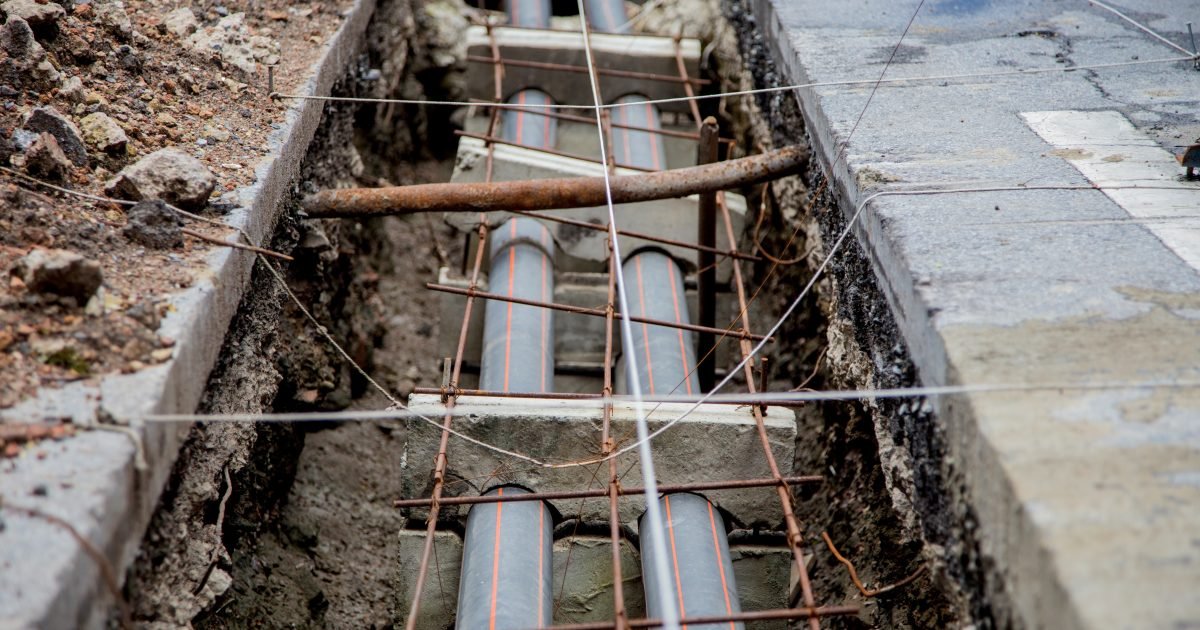

When a state highway widens from a four-lane divided road to a freeway with frontage roads, the right of way grows with it. TxDOT's notice for about five miles of Loop 338 in Ector County proposes taking the corridor from roughly 200 feet to 400 feet, and everything buried or strung inside that extra width has to move. Water, gas, power, fiber and force mains that sat comfortably beside the old road suddenly sit under a new travel lane or a drainage ditch. Utility relocation is the work of moving those lines out of the way of new construction without cutting service to the people who depend on them.
We relocate utilities for road projects, for new development that crosses existing easements, and for plants that are expanding across their own buried infrastructure. The work is rarely glamorous and it is always schedule-sensitive. A relocation that takes two weeks longer than planned can hold up a whole paving crew, so we treat it as critical path from the first pothole.
Who owns the line decides almost everything
Relocation is as much about permission as pipe. A municipal water line, a private pipeline, a telecom duct and an electrical feeder each have an owner with its own relocation rules, its own crews and its own idea of who pays. In many highway projects, the owner of a utility located in the public right of way must move it at its own cost, but a line in a private easement may be compensable. Before we price a relocation we ask for the easement documents and the utility's written position on responsibility, since the answer determines who we contract with and when payment arrives.
The second consideration is service continuity. A hospital, a plant or a neighborhood cannot lose water or power while we move a line. We plan new lines in parallel with the old, tie them in at planned shutdowns, and switch over in a controlled window. If the existing line cannot be shut off, we use bypass pumping or live-line techniques coordinated by the utility's own crews.
Matching relocation to the highway schedule
Road schedules and utility schedules rarely move together. The San Angelo North Relief Route study, covering about 11 miles on new location with a proposed 500-foot right of way, lists construction as beginning in 2032, and the listing notes that schedule is subject to change. A project like that has long lead times for utility coordination, and utilities that relocate too early can find themselves in the way of a design change, while those that move too late can stall the road.
We recommend establishing a utility coordination meeting well before the notice to proceed, and we offer to attend it as the builder who will perform the work. Relocations that are packaged with the road contract can save time, but the packaging has to be written clearly, with a named responsible party for every line. We build float into the schedule for utility owner reviews and material deliveries, because pipe, vault and transformer lead times are often longer than the construction.
Permits and agreements to expect
Relocations typically need a utility accommodation permit from the road authority, an easement or license for the new alignment, and, for lines that cross waterways or wetlands, additional environmental permits. Pipeline and gas lines may need approvals from their own regulators, and any line crossing a railroad needs the railroad's agreement. The more owners involved, the more dates on the critical path.
We help owners assemble those packages by providing construction sequencing, depth and crossing details and a traffic control plan. The relocation drawings are reviewed by each utility, and we keep a log of approvals and expirations so that no permit lapses during a delay. Where the road is a state facility, the standards for cover, encasement and separation come from the road authority, not the utility, and we read them before estimating.
Build the new line before cutting the old one
The safest relocation is a parallel one. We build the new line in the new location, test it, and only then cut the old line out of service and abandon or remove it. Where an old line must be removed, we confirm it is deenergized or drained and, for asbestos-cement or similar pipe, follow the handling rules for the material. Abandoned pipe is grouted or capped rather than left as a collapse risk under a future pavement.
Before any of this we locate every existing line within the work zone using potholing and the records of each owner. In older corridors, the records are often wrong. We survey what we find and update the plan so the relocation design reflects the real conditions, not an old set of as-built drawings. The new alignments are staked from the same control as the road so conflicts are caught on paper before they are discovered by a backhoe.
Where relocations cluster
Relocation work tracks highway and drainage construction. Along the Grand Parkway, TxDOT lists Segment E as a 15.2-mile four-lane controlled access toll road from I-10 near Katy to US 290 near Cypress, a corridor that cut through developing suburbs where water, sewer and power lines had to be moved or crossed. In West Texas, projects like the Loop 338 widening in Odessa show how oilfield-driven growth strains older infrastructure, with pipelines, power and water crowded into the same corridors the road now needs.
Oil, gas and midstream owners are frequent clients because their lines sit in rural right of way that road projects cross. Our relocation scope for them includes pipeline crossings, protective slabs and the concrete work that follows the new alignment, which ties into our site utilities package.
Why relocation estimates move
Unknown conditions drive most overruns. A line that is deeper than the records show, an unmarked second pipe beside the known one, or a different pipe material than expected changes both the method and the price. Traffic control and pavement restoration are often the largest items on a road-adjacent relocation. Rock and groundwater drive trench cost as they do on any utility job.
Owners can reduce risk by investing in subsurface utility engineering early, by agreeing a unit-price schedule for unforeseen conditions, and by deciding who holds the schedule risk for utility owner reviews. We include potholing allowances in our proposals and propose unit prices for the items most likely to vary, so that when the ground behaves differently, the cost of the difference is already agreed.
Working beside live gas, power and telecom
Relocation crews dig beside live lines, and the hazards are specific. Gas lines require locates, hand digging inside the tolerance zone and gas detection. Power lines require clearance for the excavator and boom, and underground power requires care to avoid striking energized conductors. Telecom and fiber are less dangerous to people but more expensive to damage and more disruptive to restore.
We hold a pre-task plan before any dig near a known line, assign a spotter, and stop work if conditions do not match the locate marks. When a line is damaged, the owner is called immediately and the area is controlled, regardless of how small the break looks. Our trade partners coordinate with the owner's inspectors, and for municipal and public works projects we follow the agency's own safety and traffic requirements.
Map the conflicts before they cost you
Send the road or site plan and the list of utility owners and we will help you sort responsibility, sequence and risk before the schedule is committed.
Common Questions
Who pays to relocate a utility that conflicts with a new road?
It depends on where the line sits and what agreements exist. Utilities in public right of way are often relocated at the utility owner's cost, while lines in private easements may be compensable by the road project. We ask for the easement and agreement documents before estimating so the responsible party is clear.
How long does a relocation take?
Small relocations can be done in weeks, but most are governed by approvals, material delivery and the shutdown window. Larger projects with multiple owners can take months. We map every owner and every approval into the schedule early so the dates are not discovered after the paving contractor is ready.
Can service stay on during the relocation?
Generally yes, because we build the new line in parallel and tie in during a short planned outage. Where an outage is not acceptable, bypass pumping or temporary lines carry the flow. The utility owner approves the plan, and we coordinate notifications to the people affected.
What happens to the abandoned line?
It is either removed or abandoned in place, depending on the owner and the location. In-place abandonment typically requires cutting, capping and grouting so the pipe cannot collapse or carry water. We document each abandoned segment so it appears on the as-built record.
Do you do relocations for private plants and pipelines?
Yes. Plants expanding across buried lines, and pipeline owners relocating around new roads or development, both need the same combination of locating, parallel construction, tie-in and restoration. We work within the owner's procedures and often under their safety program.