
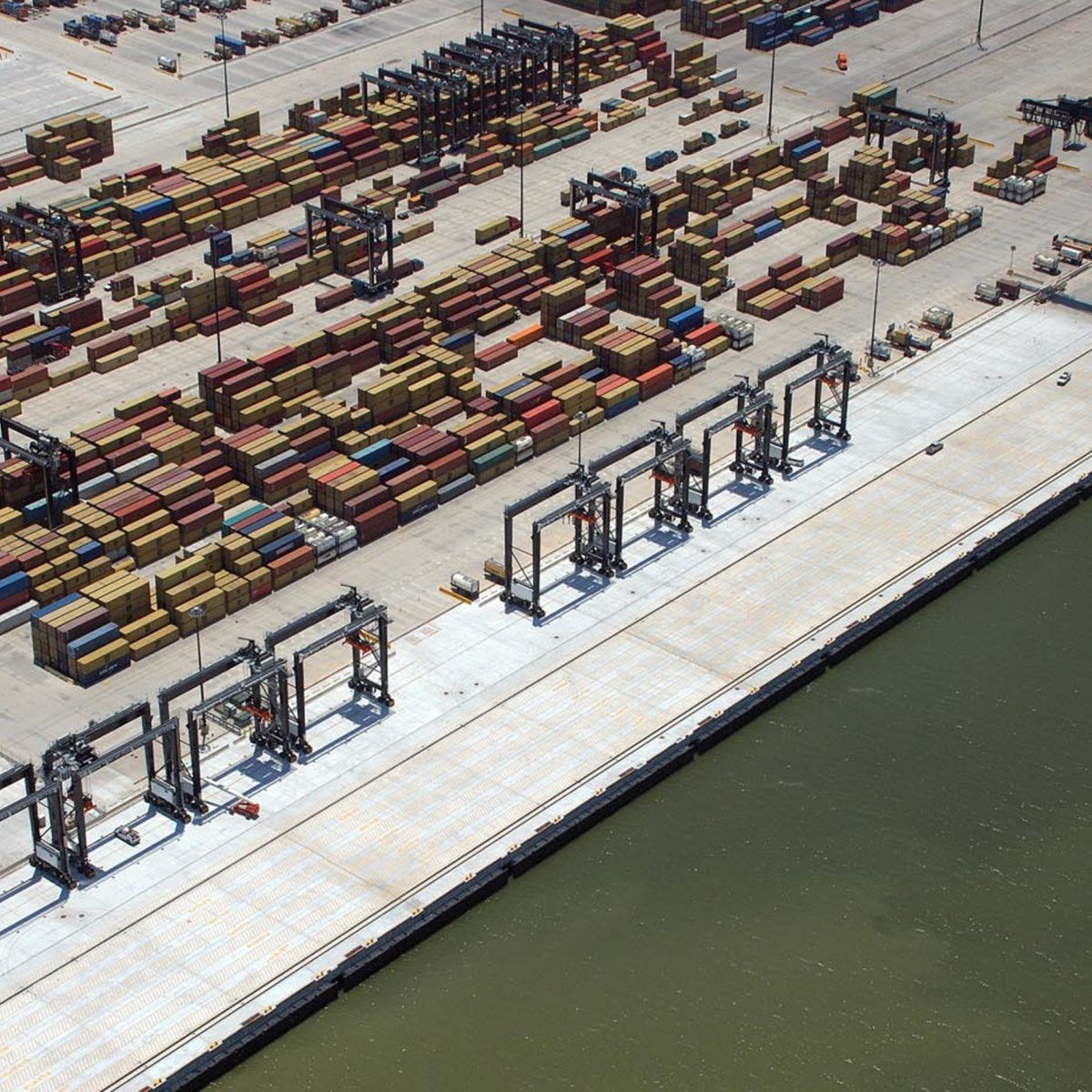

Container yards, intermodal pads and logistics buildings around a deepwater terminal need pavement that survives stacked-container loads and constant truck turning, and we build the subgrade, concrete and drainage that make that possible. Around Bayport, our work is the surface and underground infrastructure that sits behind the wharf: heavy-duty concrete paving, drainage and duct systems, truck courts and the warehouse slabs that serve the cargo.
The terminal's scale is a good guide to what this market demands. Port Houston describes the Bayport Container Terminal as designed with seven container berths and capacity for 2.3 million TEUs, on a complex with 376 acres of container yard and a 123-acre intermodal facility. Its January 2026 release states that a seventh wharf was completed just before the end of 2025, adding 1,000 feet of berth space and more than half a million TEU of capacity, and the port reports record container volumes of 4,303,345 TEUs across its public terminals in 2025.
Growth like that spills into neighboring land. Logistics owners want cross-dock, container freight station and truck parking facilities close by, and every one of them needs a pad built to take loads far heavier than ordinary commercial parking.
Capital investment behind the wharf
Port Houston's infrastructure overview says Wharf 7 gives Bayport the ability to service five ships simultaneously and that the port is investing a total of $2.1 billion landside over the next five years. The port also stated in May 2025 that the combined 25 miles of the Houston Ship Channel and Bayport Ship Channel expansion are complete, so the terminal can handle larger vessels with a capacity of 15,000 to 17,000 TEUs. Those numbers describe the demand around the terminal, and private owners on neighboring land feel it first.
For private owners, the signal is that more containers will arrive by ship, and they must move on by truck or rail. That drives demand for logistics and fulfillment centers, truck terminals and cross-docks, and the paved yards in between. Our logistics and warehouse developer clients usually start by asking what the paving needs to handle.
Pavement design is the spec that matters
The structural engineer or pavement designer sets the section, but a few principles drive what we build. Container handling equipment concentrates loads at small contact areas, so the subgrade must be uniform and the base well compacted and drained. Concrete thickness, reinforcement, joint spacing and dowels are all designed to the equipment, and we follow the plans exactly while flagging constructability issues early.
Permits follow the usual path: county or city for the site, drainage district for detention, and the owner's own approval for work inside a terminal. Local building code adoption in Texas is municipal, using the International Building Code as a baseline with amendments, and we confirm the edition with the plan reviewer. Stormwater controls matter even more beside open water, so sediment barriers are installed before excavation and maintained until stabilization.
What we place in and around a yard
Container and trailer yards need concrete paving in large, carefully jointed panels, with curb lines, trench drains and sloped inlets to move water. We also build reefer pads with electrical duct banks and pedestals, scale foundations, guard house slabs and light pole bases. Underground, we install storm drainage, fire lines and conduit, with electrical duct banks encased and marked before the paving crew arrives.
Warehouse and cross-dock buildings in the same area require the dock aprons, leveler pits and ramped truck courts that the loading dock pits and ramps crews we coordinate place. In all of it we keep a close grip on tolerances: a dock slab that is out of level by an inch makes every trailer an operational problem.
Soft ground, high water and long haul routes
Land around the bay is low, wet and often fill. We expect high groundwater, soft layers of clay and old drainage features that do not appear on the survey. Subgrade stabilization, geotextile separators and staged dewatering are common tools, and we use them where the geotechnical report supports them. When groundwater is above the work, we plan discharge to meet stormwater requirements instead of pumping and hoping.
Delivery is the other constraint. Heavy truck traffic around the terminal complicates ready-mix timing, and batch plants may be farther away than they look on a map. We confirm plant capacity, backup sources and travel time during planning. Owners also working in Pasadena or Baytown will recognize the pattern.
Why heavy-duty paving costs what it does
Concrete yards are expensive per square foot compared to ordinary parking, and the reasons are specific: thicker sections, tighter tolerances, more steel, more dowels and a larger base. Cost can be managed by right-sizing the pavement to the traffic: stacking areas and drive lanes may need heavy sections, while employee parking and overflow areas do not. We will price these areas separately so that you can see the effect.
Phasing also saves money. A yard that opens in sections lets the owner generate revenue sooner, but each phase adds joints, tie-ins and mobilizations. We help weigh those trade-offs before the contract is signed.
Heavy traffic, open water and heat
Port-side sites mix pedestrians, forklifts, tractor trailers and, often, rail movements. Our site safety plan separates those flows with barricades and signed haul routes, and every backing truck has a spotter. We also keep trenches short and shored or sloped to the soil, because soft bay-side soil can slump fast after rain. Summer heat is a daily factor, so we start early and provide water and shade for finishers working on large open slabs.
Environmental rules apply as well: fueling away from drains, spill kits at every equipment staging area and concrete washout set up in a lined, signed pit. Sites next to the ship channel get extra attention from inspectors, and we would rather pass an inspection than argue over a violation.
Building while operations continue
If you are adding to an operating yard, work must be sequenced around vessel arrivals, gate hours and peaks in truck volume. We set up barricades, coordinate gate closures with operations and schedule noisy or disruptive tasks for off-peak periods. Concrete cure time must also be built into the calendar, since a yard cannot reopen before the pavement has reached strength.
Plan your port-side project
Send the pavement design, the wheel loads and the operating constraints. We will lay out a sequence for subgrade, base, concrete placement and utilities that keeps the yard working.
Common Questions
What loads should a container yard pavement be designed for?
The designer determines that from the equipment fleet, stack heights and expected traffic. We build to the drawings and ask the engineer to confirm assumptions where a detail appears inconsistent with the stated equipment.
Why use concrete instead of asphalt in a heavy yard?
Concrete resists rutting under concentrated, slow-moving loads and fuel spills, which asphalt does not. The decision depends on cost, schedule and maintenance preferences, and the pavement designer usually evaluates both.
How do you keep a yard operating while you work?
We divide the area into phases, barricade work zones, and coordinate truck routes with operations. Each phase includes cure time before traffic is allowed back.
How do you deal with high groundwater?
We use sumps, wellpoints or staged excavation as needed, and plan discharge and sediment control to meet permit conditions. The geotechnical report helps us decide in advance.