
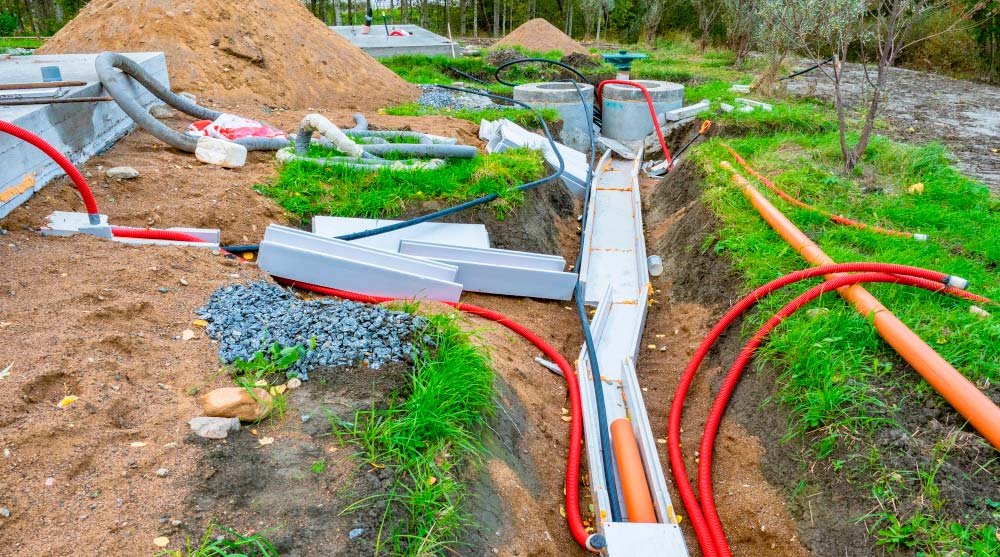

Fiber optic cable has a minimum bend radius, and a conduit run that ignores it can pass inspection and still fail the first time a technician pulls cable through it. That is the odd thing about conduit and fiber trenching: the product is empty pipe, and the test of the work comes later, when someone else tries to use it. We build the trenches, the conduit, the pull boxes and the road crossings that let communications and power cable move through a site, and we build them for the day the cable is pulled, not the day the trench is backfilled.
Most of this work is done in narrower, shallower trenches than a water or sewer line, but it covers much more distance. A campus telecom loop, a network backbone to a distribution center, a private fiber run to a gate and a conduit lane for future tenants can each add up to thousands of feet of trench on a single site. We use trenchers, rock saws and, where the surface must be preserved, directional boring to place conduit at the depth the plan requires and to put it where the owner will be able to find it again.
Trench, conduit, pull boxes and proof
A typical package starts with a trench to the specified depth, a sand or select bed and rigid, HDPE or PVC conduit laid in the arrangement shown on the plans. Where several conduits are bundled, we space them so each can be pulled independently. Sweeps and bends are long enough to respect cable bend radius, and every conduit is fitted with a pull string or rope for the installer.
Along the route we set pull boxes and handholes at the intervals the plan shows, usually at changes in direction and at set distances in long straight runs. Each is placed on a compacted base and finished to grade so traffic does not crush it. Before backfill we mandrel or proof the conduit to confirm it is clear and unkinked, and we record the route with survey points, because a conduit that cannot be located later might as well not exist. We cap the ends and mark the tracer wire so locators can follow it.
What changes a conduit plan in the field
Crossings are the main constraint. A conduit that has to cross a road, a drainage line or a rail spur might be bored under, cased, or set in an open cut with traffic control, and each choice has a different cost and a different permit. The owner of the crossed asset sets the terms, and for rail or highway crossings the review can be long. We recommend identifying every crossing early in design and asking the owner what they will allow.
The second constraint is depth. Conduits placed too shallow can be hit by future excavation, and conduits placed too deep are hard to reach and costly to repair. The plan sets a depth, but the real condition is the ground: rock, caliche or groundwater can make the planned depth expensive. Where the cover is short, we use a concrete encasement or a warning tape layer. Where the route follows a pavement edge, we coordinate with the electrical duct banks work so that power and communications do not compete for the same corridor.
Owners who rely on buried communications
Data and cloud operators build large campuses that depend on diverse fiber paths, and large projects such as the data center work reported in Abilene show how much conduit is involved when many buildings are developed together. Utilities and energy companies use conduit and fiber for protection and control signals between substations, pump stations and field equipment, and they often require specific marking and depth standards.
Industrial owners add networks for automation, security cameras and access control, and distribution centers install conduit to dock doors and gates. In planned mixed-use communities like the more than 12,000-acre Las Colinas development in Irving, shared conduit corridors are part of the infrastructure program, built once and leased or used by multiple parties. Industrial and manufacturing owners rarely want to open the same site twice, so spare conduits are common and inexpensive at the time of the first trench.
Building a route that can be found and used
We begin by locating every existing utility on the route and confirming that the conduit's planned elevation clears it. Where we cannot see the answer, we verify it with potholing. Trench excavation is staged to match the conduit installation so we do not leave long open sections. For crossings, we choose the method with the owner's engineer, whether bore, open cut or casing, and we confirm the pit sizes and entry points before the rig arrives.
Backfill and restoration are part of the same crew's work. Bedding is placed and compacted, the tracer wire is checked for continuity, and surfaces are restored to their pre-trench condition, including saw-cut asphalt and concrete patches with the correct joint pattern. At the end we deliver a route record with coordinates and depths, so the owner and the next contractor know what is beneath the site. In places like the McAllen Nearshoring Campus Industrial Park in McAllen, described as a $120 million phased investment between Idela and Ware Road, that kind of record is what lets later tenants connect without trial and error.
Work that travels with the conduit
Conduit rarely travels alone. Along the same corridors we build site utilities such as water, sewer and storm drainage, and the sequencing of those lines against the communications conduit affects the trench cut and the order of work. Handholes and vaults are often poured in place, and the manhole and vault crews we coordinate build them to the pull-box sizes shown in the plan.
At the building, we coordinate the conduit with slab penetrations, so sleeves are set before the pour, and we place the stub-ups where the low-voltage contractor expects them. Getting those elevations right at the start avoids saw cutting a finished floor later. Where a site needs both power and communications entry, we recommend a combined trench plan that shares excavation and restoration.
Walk the route with us
Send the telecom or electrical layout and we will review the crossings, the depth and the pull box spacing and tell you what we would change before the trench opens.
Common Questions
How deep should conduit be buried?
Depth is set by the owner and the governing standard, and it depends on whether the conduit is under pavement, landscaping or a roadway. Many standards call for a minimum cover measured to the top of the conduit, with greater depth at road crossings. We build to the plan and flag any location where the soil or another utility forces a change.
What is the difference between boring and open trenching?
Open trenching excavates a continuous trench, installs the conduit and backfills. Boring drills a path underground and pulls the conduit through, leaving the surface in place. Boring costs more per foot but avoids pavement cuts and traffic disruption, so it is used at roads, rails and landscaped frontages.
Can you install spare conduits for future use?
Yes, and it is usually the most economical time to do it. Extra conduits add little to trench cost, and they allow later cable additions without excavation. We label the spares and stub them at handholes so future crews can find them.
Do you pull the cable, or only build the conduit?
We build the pathway and prove that it is clear. Cable pulling and splicing are done by the low-voltage or electrical contractor. We coordinate with them on pull box locations, bend limits and pull strings so their work starts without surprises.
How do you make sure buried conduit can be located later?
We install tracer wire or marking tape where the specification calls for it, record the route with survey coordinates and depths, and set markers at handholes. For private routes, the record drawing and the tracer wire are the only reliable way to avoid a damaged line during a later dig.